
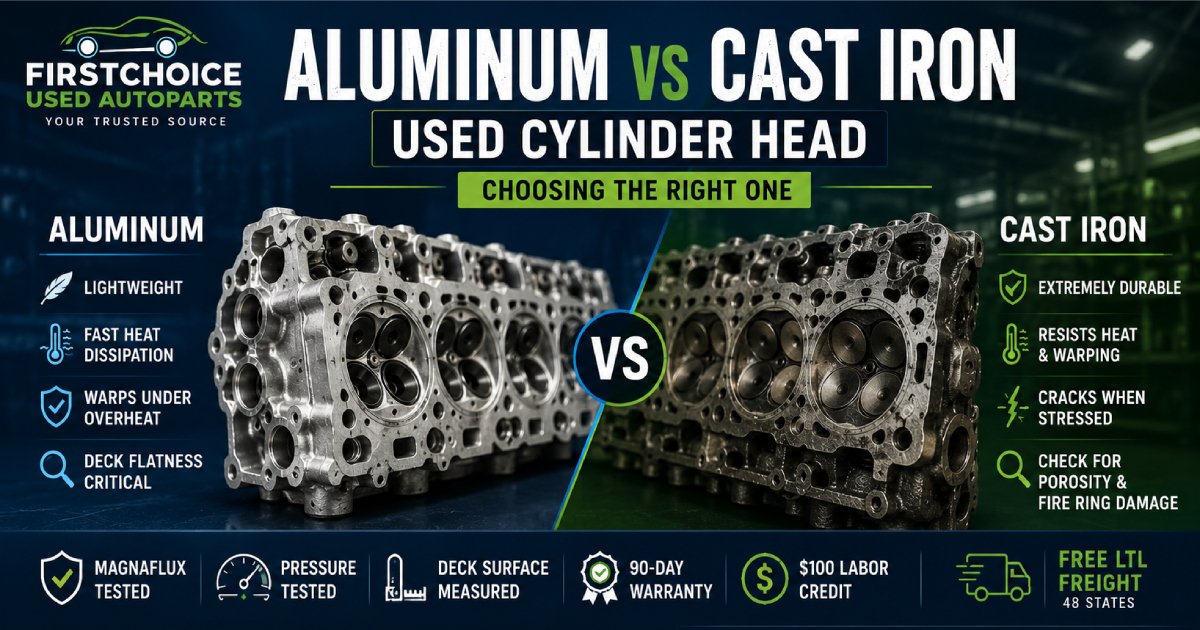
At the used-parts counter, the aluminum vs cast iron question is rarely a real choice — your engine was designed for one material and you replace with the same material. But understanding the differences matters for two reasons. First, the failure modes are different: aluminum warps under heat, cast iron resists warpage but cracks when stressed. Second, the inspection priorities are different: an aluminum head needs deck surface measurement above all else, while a cast iron head needs porosity checks and fire-ring inspection on diesels. Choosing the wrong material or accepting a used head that wasn’t inspected for the right failure mode — leads to comebacks.
This guide covers material differences as they apply to the used-parts buyer, the warpage and cracking risks specific to each, which US engines use which material, and the compatibility rule that catches builders most often: you cannot put an aluminum head from one engine on a block it wasn’t designed for. FirstChoice ships both aluminum and cast iron used heads — every one MagnaFlux tested, pressure tested, and deck-checked, with a 90-day warranty and $100 labor credit if fitment fails.
Aluminum or cast iron — Coyote, HEMI, Vortec, Duramax, Cummins, Pentastar. Every used cylinder head MagnaFlux tested and deck-measured before shipment.
Check Cylinder Head Availability →Material Differences That Matter at the Used-Parts Counter
The material a cylinder head is made from determines three things that matter to a buyer: weight, how the head handles heat, and how it fails. Aluminum is roughly one-third the density of cast iron, which is why a Coyote head weighs about 45 pounds and a Cummins 6.7L head weighs over 110 pounds. Aluminum also conducts heat about three times faster than cast iron, which is why modern high-output engines use aluminum — pulling heat out of the combustion chamber faster allows higher compression and more aggressive timing without detonation.
The trade-off is dimensional stability. Cast iron expands roughly half as much as aluminum for the same temperature change. When an engine overheats, an aluminum head expands more than the block it’s bolted to, generating stress at the head gasket joint. Cast iron heads handle the same temperature event with much less stress and far less permanent deformation. This is why heavy-duty diesel engines, where overheating is a real operational risk under load, still use cast iron heads even on modern engines.
For the used-parts buyer, the practical impact is this: aluminum heads from overheated engines are often warped beyond service limits and must be rejected. Cast iron heads from overheated engines are usually still flat and serviceable. Every aluminum head FirstChoice ships gets a deck surface measurement with a precision straightedge across multiple axes — warpage beyond 0.003 inches over the head length is a reject.
Side-by-Side Spec Table
| Property | Aluminum Head | Cast Iron Head |
|---|---|---|
| Weight (V8 single head) | ~45 lb | ~85 lb |
| Thermal conductivity | ~150 W/m·K (fast heat transfer) | ~50 W/m·K (slow heat transfer) |
| Thermal expansion coefficient | ~22 µm/m·K | ~11 µm/m·K |
| Warpage tolerance under overheat | Low — warps at sustained high temp | High — tolerates overheating events |
| Common failure mode | Deck warpage, valve seat cracks, spark plug bore failure | Cracks between valve seats, fire ring damage (diesel) |
| Repair difficulty | Difficult — aluminum welding requires specialist | Moderate — pinning and stitching established techniques |
| Typical used cost (V8) | $250–$700 | $300–$1,200 (diesel higher) |
| Used in (US fleet) | Coyote, HEMI, late Vortec, Duramax, Pentastar, 5.4L Triton | Cummins 6.7L, older Vortec (LM7 cast iron variant), classic small-block |
Which US Engines Use Aluminum vs Cast Iron
The trend in US engine design since 2005 has been overwhelmingly toward aluminum heads — even on truck engines that previously used iron. Knowing which material your engine uses tells you both what to order and what failure modes to ask about.
Ford 5.0L Coyote — Aluminum
DOHC aluminum heads. Watch for cam journal wear and valve cover stud damage on used cores.
Ford 5.4L 3V Triton — Aluminum
Aluminum head with the infamous spark plug ejection issue. Confirm spark plug threads intact on every used core.
Ford 6.7L Powerstroke — Cast Iron (CGI)
Compacted graphite iron heads. Heavy-duty diesel needs dimensional stability over weight savings.
RAM 5.7L HEMI — Aluminum
Aluminum heads on iron block. MDS vs non-MDS variants are not interchangeable.
RAM 6.7L Cummins — Cast Iron
Heavy cast iron head. Inspect for fire-ring damage at the gasket interface and crack between valves and injector bore.
GM 5.3L Vortec — Mixed
Early LM7 had iron block / aluminum heads. Later L83 / L84 aluminum throughout. Confirm engine code, not just displacement.
GM 6.2L L86 — Aluminum
DI aluminum heads. Injector bore condition critical on used cores.
GM 6.6L Duramax — Aluminum
Aluminum DOHC heads. Injector cup condition is the failure point to inspect.
Toyota 5.7L 3UR-FE — Aluminum
DOHC aluminum heads. Very low failure rate; high resale value.
Jeep 3.6L Pentastar — Aluminum
Left and right bank are different castings. Confirm side when ordering.
Warpage and Cracking — Aluminum’s Weakness
The single biggest reason a used aluminum head gets rejected at inspection is deck surface warpage. The failure pattern is consistent: vehicle overheats (stuck thermostat, failed water pump, blown lower hose), driver continues to drive on it for a few minutes too long, head reaches a temperature where aluminum yield strength is exceeded, head warps. Once warped, the head will not seal a head gasket no matter how new the gasket or how perfectly the bolts are torqued. The deck must be machined flat — or the head must be rejected.
Cracking is the second aluminum failure mode. Hairline cracks form between the valve seats, in the exhaust port floor, or around the water jacket. These cracks are usually invisible to the naked eye, which is why MagnaFlux dye penetrant inspection under UV light is the only reliable detection method. Aluminum is also harder to repair than cast iron — welding aluminum requires a TIG specialist and preheating the entire head, and the welded area is often weaker than the original casting.
Aluminum head warpage warning: If the donor vehicle history includes any overheating event, an aluminum head is suspect even if it looks fine visually. Never accept a used aluminum head without a documented deck surface measurement across at least three axes. FirstChoice rejects any aluminum head with warpage exceeding 0.003 inches over the head length.
Why Cast Iron Used Heads Are Often the Safer Bet
For engines that came with cast iron heads (Cummins 6.7L, classic small-block GM, older 4.3L Vortec V6), the used-parts purchase is often lower-risk than the equivalent aluminum head purchase. Cast iron heads tolerate thermal events much better — a Cummins head pulled from a truck that overheated once and was shut down promptly is usually still serviceable. The same event on an aluminum head usually means deck warpage and a reject at inspection.
Cast iron heads also resist the common aluminum failure modes — there is no spark plug ejection on iron (the threads hold), no deck warpage in the same temperature range, and no spider-web cracking around the water jacket. The failure modes that do occur on cast iron (cracks between valve seats on high-mileage diesels, fire-ring damage on Cummins, porosity in older castings) are all detectable by pressure test and visual inspection during MagnaFlux dye application.
The only meaningful downside of cast iron used heads is weight — shipping a Cummins head requires a sturdy crate and adds freight cost. FirstChoice ships free LTL freight, fully insured, to all 48 states on every cylinder head order regardless of weight.
Cast iron pricing tip: Heavy-duty diesel cast iron heads (Cummins 6.7L, Powerstroke 6.7L) have the highest used-vs-reman cost differential of any cylinder head category. A reman Cummins head runs $1,800–$2,800; a verified used head runs $600–$1,200. The inspection rigor on these is critical — always demand pressure test and fire-ring inspection documentation.
Compatibility — Do Not Mix Materials with Mismatched Block
An aluminum head from one engine will not work on a block it wasn’t designed for, even if the bolt pattern looks similar. The reason is dimensional — aluminum heads are designed with specific deck heights, coolant passage locations, and bolt torque specifications that match the block they ship on. A factory aluminum head on an iron block (HEMI 5.7L, LS family, Coyote on iron-block Boss variants) uses head bolts and gaskets engineered for the dissimilar-metal interface. Swapping in an aluminum head from a different family creates head gasket failures within weeks.
The rule for the used buyer is simple: match casting number to casting number. Don’t substitute based on displacement or assumed similarity. A 5.4L 3V head will not replace a 5.4L 2V head. A late L83 5.3L aluminum head will not replace an early LM7 5.3L aluminum head. A Cummins 6.7L head will not interchange with a 5.9L Cummins head despite shared block architecture. Every FirstChoice quote starts with the casting number on your old head — and ends with photo confirmation that the casting number on the replacement matches.
Aluminum or cast iron, match casting number to casting number. Free LTL freight, fully insured, real donor photos before shipment.
Find Your Used Cylinder Head →“I do 5.4L Triton swaps every couple months — they are everywhere down here. Had a 2007 F-150 in the shop with a cracked head on the right bank. Customer wanted aluminum-to-aluminum, same casting number, no aftermarket. FirstChoice sent me photos of a head from a 71,000-mile donor truck, MagnaFlux clean, deck measured 0.001 inches across — well inside spec. Bolted up first time, sealed first try, customer drove it home that Friday. The deck measurement documentation is the part I trust — anybody can say a head is good, but you need numbers.”
Related Cylinder Head Guides
Used Cylinder Head Buyer’s Guide
The four compatibility factors, cost by engine, inspection process, and 5-step ordering checklist. Start here if you are new to used heads.
Read the Buyer’s Guide →Signs of a Cracked Cylinder Head
7 symptoms with confirmation tests. White exhaust smoke, milky oil, coolant loss with no leak, misfire patterns, and cost-benefit math for used vs. reman.
Read the Symptoms Guide →Shop Used Cylinder Heads
Aluminum and cast iron heads for Ford, GM, RAM, Toyota, Jeep. MagnaFlux tested, deck measured, 90-day warranty, $100 labor credit.
Check Availability →Frequently Asked Questions
Is an aluminum cylinder head better than cast iron?
Neither is universally better. Aluminum is lighter (40–60 pounds saved per V8 head), conducts heat faster, and allows higher compression. Cast iron is dimensionally stable, tolerates overheating events, and resists warpage. Modern US engines mostly use aluminum (Coyote, HEMI, Vortec, Duramax). Heavy-duty diesel (Cummins 6.7L) still uses cast iron for thermal stability under load.
Why do aluminum cylinder heads warp?
Aluminum expands roughly twice as much as cast iron at the same temperature. When an engine overheats, aluminum exceeds yield strength and deforms permanently. Once deck surface flatness exceeds 0.003 inches over the head length, no head gasket will seal it without machining. Cast iron tolerates the same overheat with far less permanent deformation.
Can I install an aluminum head on a cast iron block?
Only if the engine was originally designed for that combination — HEMI, LS, and many factory engines run aluminum heads on iron blocks. You cannot retrofit an aluminum head from one engine to a block it wasn’t engineered for. Bolt pattern, coolant passages, deck height, and combustion chamber volume must all match. Always verify casting number against your original.
What warranty does FirstChoice offer on aluminum and cast iron cylinder heads?
Every used cylinder head — aluminum or cast iron — ships with a 90-day warranty plus a $100 labor credit if fitment fails. All heads are MagnaFlux tested, pressure tested, and deck-surface measured. Aluminum heads receive additional warpage measurement across multiple axes. Donor photos before shipment, free LTL freight, 48 states. Call 1-888-383-2439 or WhatsApp 502-751-9602.