
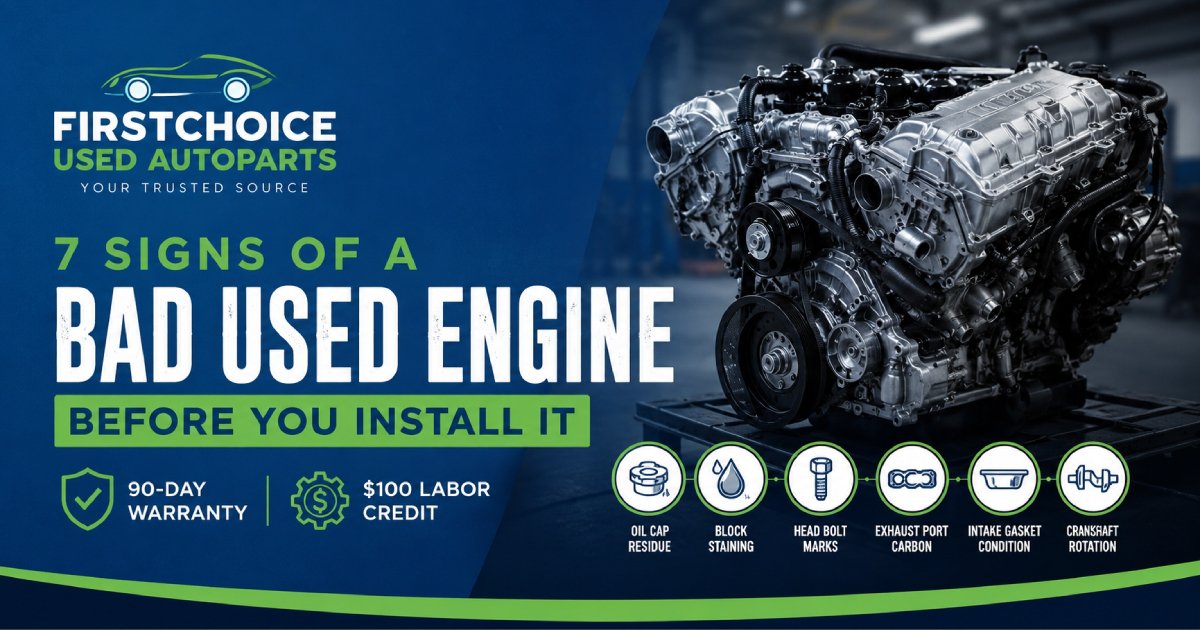
The worst used engine experience in the world is dropping the new long-block in, plumbing everything up, cranking it, and finding a knock, a coolant leak, or zero compression in cylinder three. You just bought a second teardown. This guide gives US truck and SUV owners the 7-point pre-install inspection that catches bad engines before they cost you a weekend.
FirstChoice does this inspection at intake on every engine — it is the reason the first-fit rate sits at 98.2 percent. But if you are buying any used engine, anywhere, run these checks before you commit to the swap. Twenty minutes of inspection on a pallet beats a day and a half of teardown after a failed start.
Every FirstChoice engine is pre-inspected on the 7-point checklist below. 90-day warranty + $100 labor credit if anything goes wrong.
Check Availability →The 7-Point Inspection Before You Install
These checks take less than 30 minutes total. You need a flashlight, a socket wrench, a compression tester (optional but recommended), and a clean rag. Walk through them in order.
1. Oil Cap Residue
Pull the oil filler cap. The underside should show clean dark oil residue — black or amber depending on engine type. Three failure signals:
- Milky white or tan paste: Coolant is in the oil. Head gasket, cracked head, or cracked block. Do not install.
- Heavy gold-brown varnish: Engine sat for a long time with old oil. Has likely formed deposits inside that will shed into the oil pump pickup screen on start. Negotiate a return or expect a teardown.
- Gritty black sludge: Skipped oil changes. Internal wear is worse than the odometer suggests. Possible bearing or timing chain damage.
2. Block Staining Around Water Jackets
Look at the outside of the block where the head meets the deck and around the freeze plugs. Rust streaks running down from the head or around freeze plugs indicate prior coolant leaks. If the staining is old (rust-colored, not white), the engine has been sitting and may have internal cooling-passage corrosion. If staining is white/calcium-looking, prior overheat is more likely.
3. Head Bolt Torque Markings
Look at the head bolt heads from the top of the engine. Factory engines often have paint-pen or stamp marks on the bolt heads from the assembly line. If those marks are present and intact, the heads have never been off the engine. If marks are absent or wrenched-off, the heads were removed at some point — meaning the engine was rebuilt or repaired. Not automatically bad, but a question to ask the seller.
4. Exhaust Port Carbon Patterns
Remove the exhaust manifold heat shield or look through a removed manifold opening. Each exhaust port should show similar carbon coloring — dark gray to brown. Red flags:
- One cylinder noticeably wetter/blacker than others: That cylinder is running rich or burning oil. Possible injector issue, valve seal, or ring wear isolated to one bore.
- Steam-cleaned or white port: Coolant has been burning in that cylinder. Head gasket or cracked head intruding into that combustion chamber.
- Heavy gray-white powder: Sustained coolant burning. Not repairable without head work at minimum.
5. Intake Manifold Gasket Condition
Examine the intake manifold-to-head joint. The gasket should be intact and seated. Pull marks, broken silicone bead, or evidence of recent removal means the intake was off — often to address a coolant or vacuum leak. Ask the seller why.
6. Oil Pan Damage
Lift the engine on a stand or look from below. The oil pan should be straight, not dented, not pierced. Dents in the oil pan can mean the donor vehicle bottomed out hard — and that impact often damaged the oil pump pickup screen. A pickup screen blocked by sludge or impact debris causes oil starvation on first start. Replace or inspect the pan before installation.
7. Crankshaft Rotation by Hand
With the spark plugs removed, use a socket on the crank pulley bolt to turn the crankshaft slowly two full revolutions. It should turn with steady, even resistance — about 30-40 ft-lb to overcome compression and reciprocating mass on a typical V8. Red flags:
- Sudden binding at a specific point: bent connecting rod, dropped valve, valve-to-piston contact.
- Grinding or grating sound: cam or main bearing damage.
- Free rotation with no compression resistance: blown head gasket, holed piston, or broken valve spring.
Critical: Pull spark plugs before rotating. Rotating with plugs in pressurizes the cylinders and can damage a weak head gasket, mask a bent rod, or hide a stuck valve. Plugs out, slow rotation, two complete revolutions.
Compression Test on a Used Engine
If you have a compression tester, this is the single most useful 15 minutes you can spend before installation. You can do it with the engine on a stand or after partial installation.
- Remove all spark plugs.
- Rotate engine to TDC on cylinder 1.
- Thread the compression tester into cylinder 1 plug hole.
- Bump the crank through two revolutions using a remote starter or socket on the crank bolt with assistance.
- Record the reading. Move to next cylinder.
Acceptable readings for common US gas engines:
| Engine | Expected PSI | Acceptable Variation |
|---|---|---|
| Ford 5.0L Coyote | 140 – 170 PSI | ± 10 percent |
| Ford 5.4L 3V | 140 – 160 PSI | ± 10 percent |
| Ford 3.5L EcoBoost | 150 – 200 PSI | ± 10 percent |
| GM 5.3L Vortec | 140 – 170 PSI | ± 10 percent |
| GM 6.2L L86 | 150 – 180 PSI | ± 10 percent |
| RAM 5.7L HEMI | 130 – 170 PSI | ± 10 percent |
| Jeep 3.6L Pentastar | 150 – 180 PSI | ± 10 percent |
| Toyota 5.7L 3UR-FE | 160 – 200 PSI | ± 10 percent |
One cylinder more than 10 percent below the others usually means a leaking valve, worn ring, or head gasket failure on that cylinder. Two adjacent cylinders both low usually means a head gasket leak between them — a known failure pattern on Ford 3.5L EcoBoost and GM 5.3L.
Leak-Down Test — When to Bother
A leak-down test localizes a compression problem. Apply 100 PSI of regulated shop air to each cylinder at TDC and listen for where the air escapes:
- Air at the oil filler cap: Worn rings or cylinder.
- Air at the tailpipe: Leaking exhaust valve.
- Air at the throttle body or intake: Leaking intake valve.
- Bubbles in the radiator or coolant overflow: Head gasket or cracked head.
Acceptable leak-down is under 15 percent. 15-25 percent is borderline — still installable but factor in life expectancy. Above 25 percent on any cylinder is a stop.
5 Red Flags You Can Spot in Photos Before Shipping
White Crust Around Head Bolts
Calcium coolant deposits indicate a prior head gasket leak. Engine was overheated. Walk away unless documented repair.
Rusted Exhaust Studs
Common but problematic. Manifold studs that look fully corroded will likely break during install. Plan for the headache.
Sealed Spark Plug Holes
Plugs with no visible carbon trace inside the hole look “fresh” because new plugs were installed to dress the engine for sale. Ask for tip photos.
Smashed Oil Pan or Bent Pickup
Visible from below. Donor vehicle bottomed out. Engine may have brief oil starvation events on its history.
What to Do If You Find a Problem — The $100 Labor Credit
FirstChoice ships with a 90-day warranty plus a $100 labor credit if a fitment or condition issue requires re-work. This is intentionally different from competitors who only warranty the part — leaving you on the hook for your installer’s bill.
If you receive an engine and find one of the red flags above:
- Stop the install. Do not start the engine.
- Photograph the issue clearly. Wide shot and close-up.
- Contact FirstChoice within 7 days of delivery (call 1-888-383-2439, text 502-751-9602 on WhatsApp, or email sales@firstchoiceusedautoparts.com).
- Keep your shop invoice — that is the documentation needed for the $100 labor credit.
- We arrange replacement engine + freight, plus the labor credit applied to your invoice.
Why we offer the labor credit: Most used-parts sellers warranty only the part. When fitment fails, you eat the labor cost. The $100 labor credit removes that risk on our side — we have to ship engines that actually fit, because the labor credit is real money out of our pocket if we get it wrong. It is the warranty that aligns our incentives with yours.
Pair the 90-day warranty + $100 labor credit with monthly financing through Paytomorrow. Spread the cost over 12, 24, or 36 months. Soft credit check (no impact on your score), instant pre-approval, decision in about 60 seconds.
From $185/month on a typical $4,200 engine
For shop owners: finance the engine, invoice the customer as a single labor + parts ticket, keep your working capital free for the next job. We send the financing application link with every written quote.
Cluster Reading
Used Engine Buyer’s Guide
Cost ranges, fitment factors, 5-step ordering process. The full buying playbook.
Read the Guide →Used Engine Mileage Sweet Spots
How many miles is too many — by engine family. Coyote, Vortec, HEMI, Cummins, Duramax, Pentastar.
Read the Mileage Guide →Shop Used Engines
Pre-inspected, VIN-verified, photos before ship. 90-day warranty + $100 labor credit.
Check Availability →“Ordered a 5.7L HEMI from FirstChoice for my 2014 Ram 1500. When the engine arrived I did the 7-point inspection — found white residue under the oil cap that wasn’t there in the original photos. Texted them on WhatsApp with a photo, they had a replacement engine on a truck within 48 hours and credited the $100 toward my installer’s time on the second drop-in. That kind of response is why I’ll buy from them again.”
Pre-inspected used engines with the warranty that actually covers your shop bill if something goes wrong.
Get a Quote →Frequently Asked Questions
What are the signs of a bad used engine before installation?
The 7 critical pre-install checks are: oil cap residue (white/milky = coolant in oil), block staining (rust streaks around water jackets), head bolt torque marks (paint markings undisturbed), exhaust port carbon (heavy black = rich-running cylinder), intake manifold gasket condition, oil pan dents (indicates impact), and crankshaft rotation by hand (should turn smoothly with no binding).
Can I compression test a used engine before installing it?
Yes, with a compression tester and an air supply. Remove the spark plugs, rotate the crank to TDC on each cylinder, and read compression. Healthy gas engines read 130-180 PSI per cylinder with no more than 10 percent variation between cylinders. Diesel compression tests require a diesel-specific tester rated to 600+ PSI.
Should I do a leak-down test on a used engine?
A leak-down test is worth doing if compression numbers are borderline or if you want to localize a leak. Apply 100 PSI of regulated air to each cylinder at TDC and listen for escape: at the oil cap (rings), tailpipe (exhaust valve), throttle body (intake valve), or radiator (head gasket). Acceptable leak-down is under 15 percent.
What does milky white residue inside the oil cap mean?
Milky white or tan residue inside the oil cap usually means coolant has entered the oil — almost always a head gasket failure, cracked head, or cracked block. Do not install. This is a critical red flag that warrants returning the engine before installation.
What does FirstChoice do if I find a problem after delivery?
Every engine ships with a 90-day warranty plus a $100 labor credit if a fitment or condition issue requires re-work. Photograph the problem, contact FirstChoice within 7 days of delivery, and we will arrange replacement or refund plus the labor credit. Most issues are caught at the donor-vehicle inspection stage, which is why our first-fit rate is 98.2 percent.