
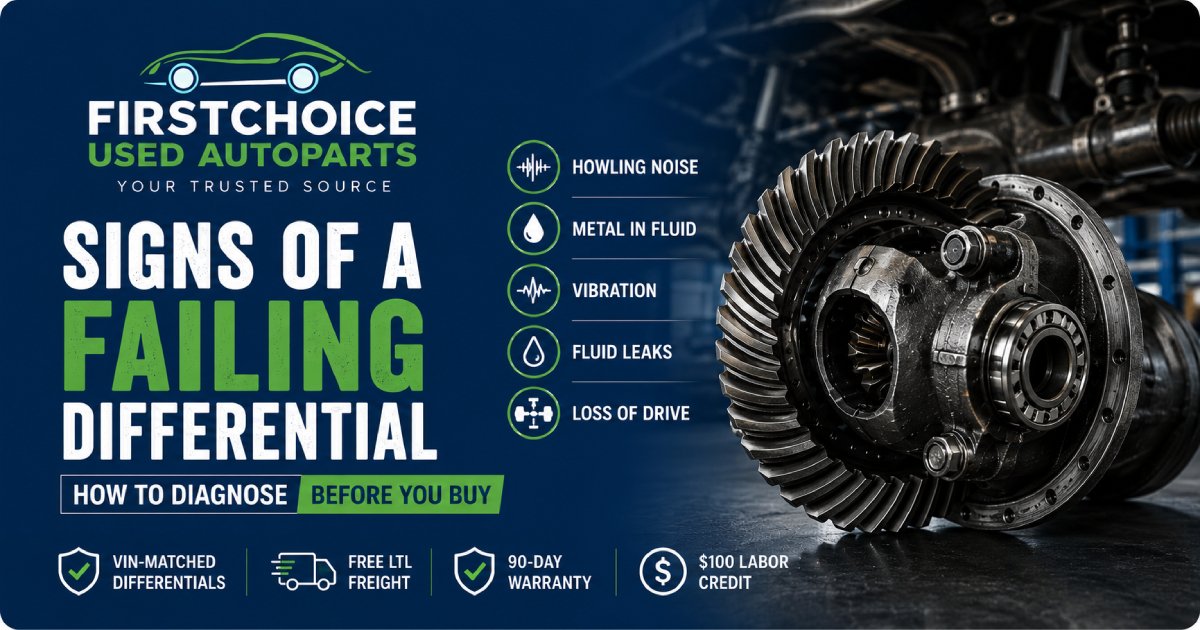
The howl that started at 60 mph two months ago is louder now. The fluid you drained has shiny metal in it. Before you spend $400-$900 on a replacement differential, this guide gives US truck and SUV owners the 8 symptoms to verify, the 4 confirm-before-you-buy tests, and a straight answer on whether to rebuild the existing carrier or swap in a complete used differential.
FirstChoice ships VIN-matched complete differentials for Ford 8.8 and 9.75, GM 8.6 and 9.5, RAM AAM 9.25 and 11.5, Toyota 8.4 and 9.5, Jeep Dana 35/44, and Dana 60. Free LTL freight, 90-day warranty, $100 labor credit if fitment fails. But before you order, make sure the differential is what actually failed — sometimes it is the wheel bearing or the U-joint, not the diff itself.
Diagnosed your diff and ready to order? VIN-match in 10 minutes. Free LTL freight + 90-day warranty.
Check Availability →The 8 Symptoms of a Dying Differential
1. Howling or Whining That Tracks With Vehicle Speed
The most common symptom. Listen at 30, 45, and 60 mph. If the noise pitch rises and falls with vehicle speed (not engine RPM), it is the differential. If it changes with engine RPM independent of vehicle speed, it is the transmission or torque converter, not the diff. Differential howl that gets louder under load (accelerating up a hill) usually points to the ring and pinion. Howl on deceleration (coasting down a hill) usually points to the pinion bearing.
2. Clunking on Takeoff or Shifting
A solid clunk from the rear when you take off from a stop, or when you shift from drive to reverse, is excessive backlash between the ring gear and pinion. As gear teeth wear, the gap between them grows. The clunk is the slack taking up under load. Often combined with howl.
3. Vibration That Increases With Speed
A vibration that gets worse as speed increases can be the differential, the driveshaft, or the wheel bearings. Differential vibration usually shows up at 35-55 mph and feels like it is coming from under the back seat. Driveshaft vibration shows up at 60-75 mph and feels like it is coming from the floor. Wheel bearing vibration tracks with one wheel and can be isolated by swerving (load shift changes it).
4. Fluid Leak Around Differential
Check three places: the differential cover gasket, the pinion seal (where the driveshaft enters the diff), and the axle shaft seals (where the axles exit the housing). A pinion seal leak by itself is a $25 fix — replace the seal. A cover gasket leak is also cheap. But if you see oil weeping from multiple seals on a high-mileage diff, the internal pressure has risen from wear-related heating — meaning more wear is coming.
5. Metal Flakes in the Differential Fluid
Drain a small amount of differential fluid into a clean white container and let it settle. A faint magnetic powder on a magnet is normal — gear wear over time. Visible metal flakes, especially shiny silver chips, mean active gear or bearing damage. Time to replace soon.
6. Broken Teeth in the Drain
If you find actual tooth fragments — pieces of metal larger than a grain of rice — the ring or pinion has broken teeth. Driveable but on borrowed time. Repair now or be towed soon.
7. ABS Light With No Wheel-Speed Sensor Code
The rear axle tone ring (the toothed ring the ABS sensor reads) is mounted on the differential carrier or the axle shaft itself. If the tone ring is damaged from internal differential debris, the ABS sensor reads erratic pulses and the ABS light comes on. A scan tool reads a “wheel speed sensor signal erratic” code with no actual sensor failure — meaning the diff is the source.
8. Complete Loss of Drive
The differential locked up or a spider gear failed. The truck does not move under power. Easy diagnosis but expensive — you are now buying a complete diff, not a rebuild kit.
Symptom-to-Component Matrix
| Symptom | Most Likely Failed Component |
|---|---|
| Howl under acceleration only | Ring and pinion (drive side) |
| Howl on deceleration only | Pinion bearing (coast side) |
| Howl at all speeds | Carrier bearings or severe ring/pinion wear |
| Clunk on takeoff, no howl | Excessive backlash, possibly worn yoke |
| Clunk on turns only | Spider gears in carrier (LSD or open) |
| Whine at all speeds, no load change | Pinion bearing or pinion preload off |
| Vibration at 40-55 mph | Differential or driveshaft balance |
| No drive, no noise | Internal spider gear failure |
| No drive, loud bang preceded | Broken axle shaft or ring gear tooth |
The 4 Confirm-Before-You-Buy Tests
Test 1: Fluid Inspection
Drain a small amount of differential fluid into a clean container. Use a magnet to check for ferrous debris. Look for:
- Light gray powder on magnet, fluid still amber: Normal wear. Keep driving.
- Heavy gray paste on magnet, fluid darker: Bearing wear. Plan replacement within 6 months.
- Visible metal flakes in fluid: Active gear damage. Replace soon.
- Tooth fragments: Catastrophic damage in progress. Stop driving until replaced.
Test 2: Pinion Play Check
With the truck on a lift or jack stands and the parking brake released, grip the driveshaft yoke (right where it meets the differential pinion) and try to move it up and down, then forward and backward.
- Less than 0.005 inches of vertical play: pinion bearings are healthy.
- Visible vertical movement (more than 0.005 inches): pinion bearings worn. Plan replacement.
- Forward and backward play more than 0.020 inches: severely worn pinion bearings. Replace now.
Test 3: Gear Lash Measurement
With the differential cover off, mount a dial indicator on the ring gear and measure the backlash between ring and pinion. Factory spec is typically 0.005-0.010 inches. Above 0.012 inches indicates worn teeth. This test is best done by an experienced mechanic — the cover removal and re-install requires care.
Test 4: Gear Pattern Check
Paint marking compound on the ring gear teeth, rotate by hand, and inspect where the pinion contacts. Pattern centered on tooth = healthy. Pattern off-center toward heel or toe = worn or out-of-adjustment ring and pinion.
The 30-minute home test: Tests 1 and 2 take 30 minutes with basic tools and confirm the diagnosis without removing the cover. If your fluid shows metal AND you have pinion play, you have differential failure. Both bad = order replacement.
When to Replace the Whole Diff vs Rebuild the Carrier
| Condition | Recommendation | Typical Total Cost |
|---|---|---|
| Pinion seal leak only, no noise | Replace pinion seal | $50 – $200 |
| Light howl, no metal in fluid | Drain, refill with fresh fluid, monitor | $60 – $120 |
| Howl + light metal flakes | Rebuild kit (ring/pinion/bearings/seals) at shop | $800 – $1,500 |
| Howl + heavy metal + tooth chips | Used complete differential | $400 – $900 installed |
| Catastrophic failure, axle housing damage | Used complete rear axle assembly | $600 – $1,200 installed |
For most US truck owners, the math favors a used complete differential when the howl gets metal in the fluid. A rebuild kit at a shop runs $800-$1,500 total. A used complete diff from FirstChoice runs $300-$700 plus install labor — same labor either way, lower parts cost.
Cost of Ignoring It
What happens after the howl, in order:
- Howl gets louder. Wear accelerates as gear surface roughens.
- Metal in fluid increases. Each pass through the gear loses microscopic material.
- Bearings overheat. Roughness creates friction; friction creates heat.
- Pinion bearing seizes. Pinion stops turning; ring gear keeps turning. Result: broken teeth.
- Tooth fragments wedge between ring and carrier. Differential locks.
- Differential lock-up at speed. Rear wheels stop turning instantly while front continues. Vehicle can spin out.
- Axle housing damage from debris. Now you need the complete axle assembly, not just the diff.
The cost progression: $400-$900 (replace diff at howl stage) → $600-$1,200 (complete rear axle at catastrophic failure stage) → up to $4,000 (towing, insurance, and rental during repair on a working vehicle).
Cluster Reading
Used Differential Buyer’s Guide
Cost by truck, the 4 compatibility factors, used vs rebuilt vs new comparison, and the 5-step ordering process.
Read the Buyer’s Guide →Differential Gear Ratio Guide
Find your gear ratio from VIN, RPO sticker, axle tag, or manual count. Critical for ordering the right used diff.
Read the Ratio Guide →Shop Used Differentials
Ford, GM, RAM, Toyota, Jeep. Gear ratio confirmed, LSD verified, photos before ship.
Check Availability →“My 2015 RAM 2500 started howling at 50 mph in October. I let it go through tow season because I had a horse trailer to move. By February I was finding metal in the diff fluid. Drained it, did the pinion play check — 1/8 inch of up-down movement. Called FirstChoice with my SPID code, they matched a 71,000-mile AAM 11.5 with my 3.73 ratio. $640 shipped, my shop did the swap in under three hours. Saved at least $700 versus a rebuild and probably avoided a roadside breakdown on a trailer day.”
How I confirmed? VIN-match a replacement differential today. Free LTL freight, 90-day warranty, $100 labor credit.
Get a Quote →Frequently Asked Questions
What are the symptoms of a failing differential?
The 8 most common symptoms are: howling or whining noise that tracks with vehicle speed, clunking on takeoff or shifting, vibration that increases with speed, fluid leak around the differential cover or pinion seal, metal flakes in the differential fluid, broken teeth in the fluid drain, ABS light from a damaged tone ring, and complete loss of drive. Howl on deceleration usually means pinion bearing; howl under load usually means ring and pinion.
How do I diagnose a differential problem before buying a replacement?
Four tests confirm differential failure: 1) Drain a small amount of fluid and check for metal flakes — large flakes mean ring and pinion damage. 2) Check pinion play by trying to move the driveshaft yoke up and down — more than 0.005 inches indicates bearing wear. 3) Measure gear lash with the cover off and a dial indicator. 4) Check the gear pattern with marking compound. If three of four show problems, replace the differential.
Can I just rebuild the differential carrier instead of replacing it?
Yes, but the math depends on what failed. A rebuild kit (bearings, seals, ring and pinion) runs $300-$600 in parts plus $500-$900 labor — total $800-$1,500. A used complete differential from a low-mileage donor runs $400-$900 installed. For most US truck owners the used path saves money and skips the bearing-press labor.
What happens if I ignore a failing differential?
Ignored differential failures progress from noise to metal debris, then to catastrophic gear seizure. A seized differential can lock the rear wheels at speed — a serious safety risk — or destroy the axle housing requiring full assembly replacement instead of just the differential. Replace at the noise stage, not the seizure stage.
How long can I drive on a howling differential?
Most differentials can run 5,000-15,000 miles after the howl starts, depending on severity and load. Light-duty daily driving with light howl: longer. Heavy towing or hauling: shorter. Once you start finding metal flakes in the fluid, you have approximately 1,000-3,000 miles before catastrophic failure.