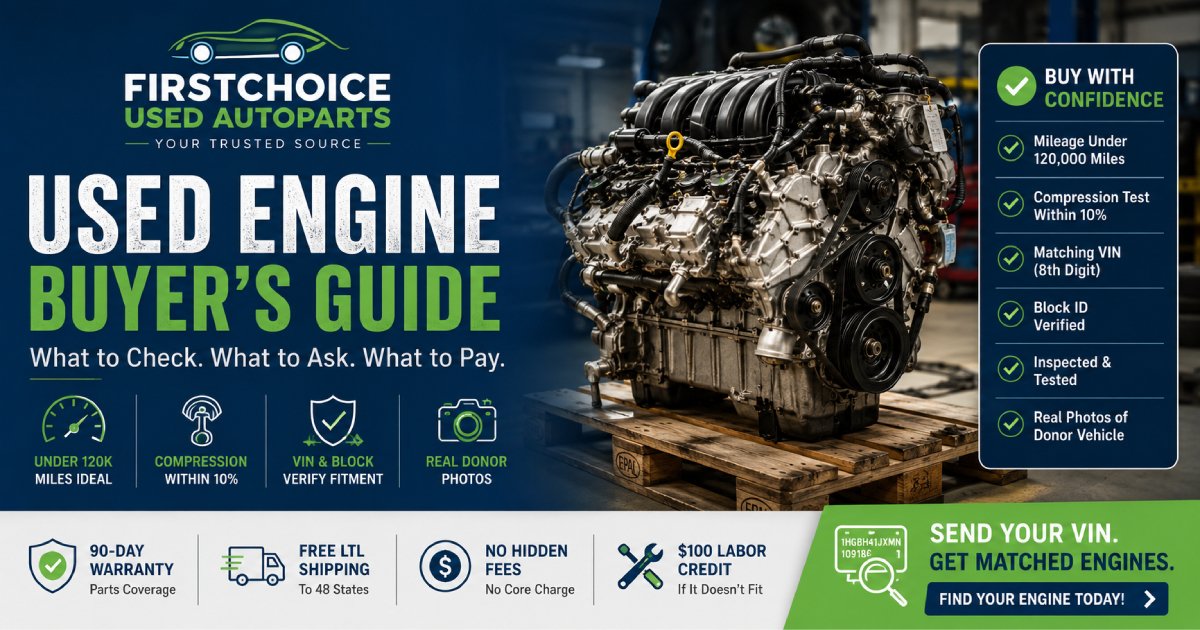
A used engine is the right choice when your truck or SUV is worth more than a new long-block costs. The right used engine has under 120,000 miles, passes a compression test within 10 percent across cylinders, matches the 8th digit of your VIN, and ships from a verified donor with real photos. That is the entire buyer’s playbook in one paragraph.
This guide walks Ford, GM, RAM, Toyota, and Jeep owners through the full process — cost ranges, fitment verification, inspection checkpoints, and the five-step ordering process FirstChoice uses to hold a 98.2 percent first-fit rate on over 3,400 drivetrain shipments in 2025. By the end you will know exactly what to ask, what to inspect, and what a fair price looks like for your specific engine.
VIN-verified used engines with real donor photos. 90-day warranty + $100 labor credit if it doesn’t fit.
Check Availability →Why Used Engines Make Sense for US Truck and SUV Owners
A new crate 5.3L Vortec from a dealer runs $7,800 to $9,500 before labor. A reman costs $4,500 to $6,000. A verified used 5.3L with 85,000 miles from a clean donor truck costs $1,900 to $2,800 — and on a 2014 Silverado worth $14,000, that math is the difference between fixing the truck and walking away from it.
For US buyers the calculation gets even sharper in three situations:
- Tax-refund season replacements. Shops in Texas, Florida, and Arizona see a spike in February through April when DIY owners use their refund to swap an engine instead of trading the truck in.
- Salt-belt vehicles. A 2016 F-150 from Ohio or Pennsylvania with a rotted exhaust manifold and 180K on the clock is the perfect candidate — body is still solid, just needs a clean 5.0L from a Texas or Arizona donor.
- Pre-towing season prep. RV haulers and trailer guys want their drivetrain sorted before Memorial Day. A used engine bought in March beats a backordered reman in May every time.
The risk is real, though. A wrong-spec engine costs you the freight back, the labor to pull it again, and a week of downtime. That is exactly the problem the VIN-verification and donor-photo workflow below was built to solve.
Used Engine Cost by Make and Model
Pricing varies with mileage, model year, and supply. These ranges reflect FirstChoice’s 2025 sale data on engines under 120K miles, shipped with the 90-day warranty and free LTL freight included.
| Engine | Common Vehicles | Typical Price (Used) |
|---|---|---|
| 5.0L Coyote V8 | 2011-2024 Ford F-150, Mustang GT | $1,800 – $2,800 |
| 3.5L EcoBoost V6 | 2011-2024 F-150, Expedition, Explorer | $2,100 – $3,400 |
| 6.7L Power Stroke Diesel | 2011-2023 Ford Super Duty F-250/F-350 | $4,500 – $7,800 |
| 5.3L Vortec / EcoTec3 | 2007-2024 Silverado, Sierra, Tahoe, Yukon | $1,900 – $2,800 |
| 6.2L L86 / L87 V8 | 2014-2024 Silverado 1500, Tahoe, Escalade | $2,800 – $4,200 |
| 6.6L Duramax LML/L5P | 2011-2024 Silverado 2500/3500, Sierra HD | $5,200 – $8,500 |
| 5.7L HEMI V8 | 2009-2024 RAM 1500, Durango, Grand Cherokee | $2,200 – $3,400 |
| 6.7L Cummins Diesel | 2007-2024 RAM 2500/3500 | $5,500 – $8,200 |
| 3.6L Pentastar V6 | 2011-2024 Jeep Wrangler, Grand Cherokee, RAM 1500 | $1,400 – $2,200 |
| 5.7L 3UR-FE V8 | 2007-2021 Toyota Tundra, Sequoia, Land Cruiser | $2,400 – $3,800 |
| 3.5L 2GR-FKS V6 | 2016-2024 Toyota Tacoma, Highlander | $1,800 – $2,900 |
Pro tip: If a quote is more than 25 percent below the ranges above, ask for the donor VIN, mileage source (odometer or dashboard photo), and a compression reading. Real used engines have real paperwork.
Spread your engine cost over 12, 24, or 36 months through Paytomorrow. Soft credit check (no impact on your score), instant pre-approval, decision in about 60 seconds.
Most shop owners use this to keep working capital free and invoice the customer as a single labor + parts ticket.
Ask for the monthly math when you request your quote — we send the financing application link with every written quote.
The 3 Non-Negotiable Compatibility Factors
Most failed swaps are not bad engines — they are wrong engines. Three checks catch 95 percent of fitment errors before money changes hands.
1. Engine Code (8th Digit of VIN)
The 8th character of your 17-digit VIN identifies the exact engine family. A 2018 F-150 with VIN …F… is a 5.0L Coyote. The same year truck with …T… is a 3.5L EcoBoost. They look similar in the engine bay. They are not interchangeable. We cover the full code charts in our VIN compatibility guide.
2. Engine Block Casting / ID Number
Inside the engine family there are sub-variants. A 2014 5.3L L83 and a 2019 5.3L L84 share displacement but have different fuel systems, cam profiles, and ECU calibrations. The casting number stamped on the block (usually near the bellhousing or behind the alternator) confirms the exact variant.
3. Accessory Configuration
Two identical long-blocks can still mismatch on:
- Oil pan style — 4WD trucks use a different sump than 2WD.
- Flywheel vs flexplate — manual transmission vs automatic.
- Intake manifold and throttle body — drive-by-wire vs cable, single vs dual knock sensor.
- Sensor count and connector type — early 5.3L = 24x crank sensor, later = 58x.
- AC compressor and alternator brackets — Tahoe SUV vs Silverado pickup differ.
Common buyer mistake: Ordering by “year, make, model” alone. A 2015 Silverado came with three different 5.3L variants depending on trim and emissions package. Always send the full VIN.
How to Verify a Used Engine Before Buying
Once the seller confirms the right engine is in stock, you verify health. Here is the exact sequence FirstChoice’s tech team runs on every drivetrain part before it ships.
Compression Test
Each cylinder is tested with the throttle held open, all plugs removed, and the engine cranked through 4-6 compression strokes. Acceptable readings:
- Gas V8s (5.0L, 5.3L, 5.7L, 6.2L): 150-185 PSI per cylinder, all within 10 percent of each other.
- V6 gas (Pentastar, EcoBoost off-boost, 2GR): 130-170 PSI per cylinder.
- Diesel (Cummins, Power Stroke, Duramax): 350-500 PSI, within 10 percent across cylinders.
A single cylinder reading 20 percent low usually points to a burnt valve, broken ring, or head gasket leak.
Leak-Down Test
When compression numbers are borderline, a leak-down test pressurizes each cylinder at TDC and measures the percentage that escapes. Under 10 percent = healthy. 10-20 percent = serviceable. Over 25 percent = problem. The advantage of leak-down: you can hear where the air goes (exhaust pipe = exhaust valve, intake = intake valve, oil cap = rings, radiator = head gasket).
Oil Pan and Pickup Inspection
Drop the oil pan. Look for:
- Bearing material (silver flake) — indicates worn rod or main bearings.
- Coolant streaks — head gasket failure or cracked block.
- Metal chunks larger than glitter — broken timing component or oil pump damage.
- Sludge thicker than honey — neglected maintenance, walk away.
Block ID and Visual Inspection
Confirm the casting number matches the expected variant. Check the block deck for visible cracks, the cylinder bores for scoring, and the head bolt holes for stress fractures. On diesels, inspect the EGR cooler ports for excessive carbon and the head studs for the correct torque marks.
FirstChoice difference: Every drivetrain part includes real photos of the donor vehicle, the engine in the bay, the VIN tag, and the odometer before it leaves Louisville. You see exactly what you’re buying.
Get real donor photos, compression readings, and a fitment match before you commit. 98.2% first-fit rate.
Request a VIN Match →The 5-Step Ordering Process at FirstChoice
- Send your VIN. Call 1-888-383-2439, email sales@firstchoiceusedautoparts.com, or WhatsApp 502-751-9602 with the 17-digit VIN of the vehicle receiving the engine. We pull factory build sheet data.
- Receive matched engine options. Within a business day you get 1-3 candidate engines with mileage, donor vehicle year and trim, location, and price. Real photos included.
- Approve and pay. No hidden core charges. Free LTL freight to 48 states. Fully insured in transit.
- Engine ships in 2-4 business days. You get tracking. Most engines arrive within 5-9 business days.
- Inspect on delivery. 90-day warranty starts on receipt. If it doesn’t fit your VIN as quoted, $100 labor credit kicks in.
Used vs Rebuilt vs Remanufactured: Quick Comparison
“Used” is not your only option, and it isn’t always the right one. A daily-driver Camry with 280K miles might call for a used engine. A diesel hauler with another 10 years of work in it might justify a reman. We cover the full decision matrix in our companion piece on used vs rebuilt vs remanufactured engines, but here is the short version:
- Used ($1,200-$3,500): 90-day warranty, fastest delivery, best value for vehicles under $20K market value.
- Rebuilt ($2,500-$5,500): 1-3 year warranty, individual shop quality varies widely.
- Remanufactured ($3,500-$8,000): 3-5 year warranty, OEM-spec rebuild, longest lifespan, longest lead time.
US Customer Story: 2017 F-150 5.0L Coyote — Houston, TX
“I run a small independent shop in northwest Houston and had a customer with a 2017 F-150 XLT, 5.0L Coyote, 142K on the odometer. He spun a rod bearing on a tow back from Galveston. Local crate engine quote came back at $8,400 plus labor. I called FirstChoice on a Thursday, sent the VIN, and by Friday afternoon I had three Coyote options with photos. Picked an 81K-mile engine out of a wrecked Mustang GT for $2,650 delivered. Engine showed up Wednesday on an LTL truck, oil pan was clean, compression readings came over with the paperwork, all cylinders 168-174 PSI. Dropped it in over the weekend, fired on the first crank. Saved my customer $5,000 and I had the truck back on the road in 9 days from the first phone call.”
Related Reading
Ready to find your engine? Send us your VIN and get matched options within one business day.
Start Your VIN Match →Frequently Asked Questions
What mileage is acceptable on a used engine?
For most US trucks and SUVs, a used engine between 60,000 and 120,000 miles is the sweet spot. Coyote 5.0L and HEMI 5.7L do well at 60K-100K, Vortec 5.3L at 70K-120K, and Cummins 6.7L diesels can run safely at 100K-200K when properly serviced.
Should I get a compression test before buying a used engine?
Yes. A compression test (or a leak-down test) is the single best indicator of engine health. Cylinders should read within 10 percent of each other and meet the factory minimum spec (typically 130-180 PSI for gas engines). FirstChoice provides donor vehicle photos and engine readings on request.
How do I verify a used engine fits my vehicle?
Cross-check three items: the 8th digit of your VIN (engine code), the engine block casting number, and the accessory configuration (intake, sensors, oil pan, flywheel/flexplate). FirstChoice VIN-verifies every engine before it ships, which is why we hold a 98.2 percent first-fit rate.
What warranty comes with a used engine from FirstChoice?
Every used engine ships with a 90-day parts warranty plus a $100 labor credit if the engine arrives with a fitment issue. Free LTL freight to 48 states is included and the engine is fully insured in transit.
How long does it take to receive a used engine?
Most engines ship within 2-4 business days of VIN verification and arrive within 5-9 business days depending on the destination. We provide tracking on every LTL shipment.